



GLP-1 Pills vs Injections: Do They Work as Well?
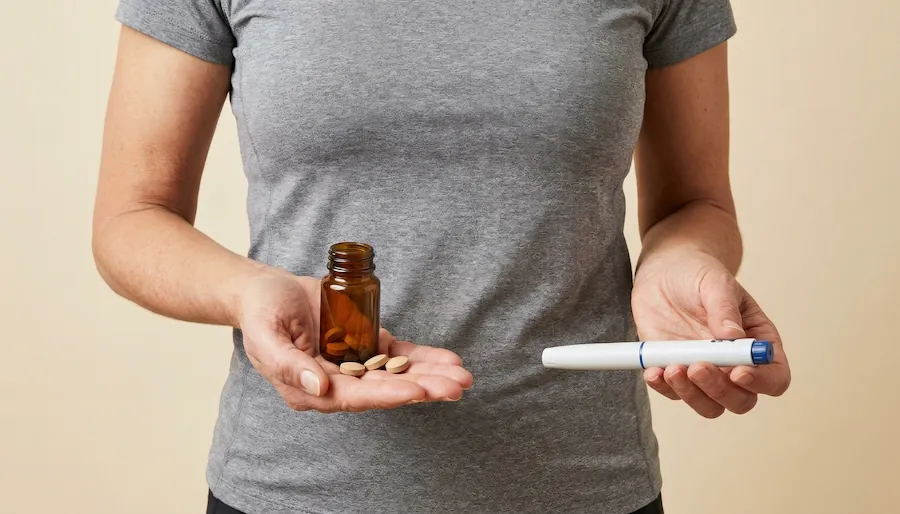
With the growing popularity of GLP-1 medications for weight loss, many patients are asking a very practical question:
“Can I take a pill instead of giving myself an injection?”
At St. Louis Bariatrics, this comes up often, especially from patients who are interested in medications like semaglutide or tirzepatide but feel hesitant about injections.
The short answer is that there are oral GLP-1 options, but they are not exactly the same as injections, and that difference matters.
What are GLP-1 pills?
GLP-1 medications are designed to help regulate appetite, reduce cravings, and improve feelings of fullness.
Most well-known options, like semaglutide and tirzepatide, are injections. However, there are also oral versions (pills) that deliver similar types of medication through the digestive system.
The key difference is how the medication enters your body:
- Injections are absorbed directly into the bloodstream
- Pills must be absorbed through the stomach and intestines
This difference plays a major role in how effective the medication can be.
Do GLP-1 pills work as well as injections?
In general, GLP-1 pills are less consistently effective than injections.
This comes down to absorption. When you take a pill, your body has to break it down and absorb it through the digestive tract. Not all of the medication makes it into your bloodstream.
With injections, the medication bypasses this process and is delivered more directly, which leads to:
- More predictable dosing
- Stronger appetite suppression
- More consistent results for many patients
That does not mean pills do not work. They can be helpful for some patients, but expectations should be realistic. Results vary, and they may not match what patients see with injectable medications.
Why do some patients prefer pills?
Even with differences in effectiveness, many patients are drawn to oral options for understandable reasons.
Some simply do not like the idea of injections. Others prefer the routine of taking a daily pill rather than managing a weekly injection.
These preferences matter. The “best” treatment is not just what works on paper, it is what a patient can realistically stick with over time.
Can you take GLP-1 pills after bariatric surgery?
Yes, patients can take GLP-1 pills after bariatric surgery, but this is where things become more nuanced.
Procedures like gastric sleeve and gastric bypass change how the stomach and intestines function. Because oral medications rely on absorption through the digestive system, patients may not absorb the full dose as intended.
This can lead to:
- Reduced effectiveness
- Less predictable results
- The need for closer monitoring
For this reason, injectable GLP-1 medications are often preferred after bariatric surgery, since they do not depend on the altered digestive pathway.
Dr. Jay Michael Snow, MD, a board-certified bariatric surgeon and Medical Director at Mercy Hospital Jefferson, has extensive experience treating patients both before and after surgery. With over 11,000 patients treated, he emphasizes that post-surgical anatomy plays a major role in how medications work, and treatment decisions should reflect that.
Are GLP-1 pills cheaper than injections?
Cost is one of the most common reasons patients ask about oral options.
In some cases, GLP-1 pills may appear less expensive upfront, especially for patients paying out of pocket. However, the full picture depends on:
- Insurance coverage
- Dosage requirements
- Long-term effectiveness
If a medication is less effective, patients may not see the results they are hoping for, which can impact overall value.
At St. Louis Bariatrics, cost discussions are part of the treatment planning process so patients understand both short-term and long-term considerations.
Who is a good candidate for GLP-1 pills?
Oral GLP-1 medications may be a reasonable option for:
- Patients early in their weight loss journey
- Patients with mild to moderate weight loss goals
- Patients who strongly prefer to avoid injections
They may be less ideal for:
- Patients who have had bariatric surgery
- Patients needing significant weight loss
- Patients who have not responded to oral medications in the past
The decision is not just about preference. It is about choosing the approach that aligns with your body and your goals.
When injections or surgery may be a better option
For patients seeking more substantial or durable weight loss, injectable medications or bariatric surgery may offer more reliable results.
Injections provide stronger and more consistent medication delivery. Surgery, on the other hand, creates metabolic and hormonal changes that do not rely on ongoing medication alone.
At St. Louis Bariatrics, both options are part of a broader strategy, not competing choices, but tools that can be used at different points in a patient’s journey.
A physician’s perspective on choosing the right option
Dr. Jay Michael Snow’s approach is rooted in individualized care. With fellowship training at the Minnesota Institute for Minimally Invasive Surgery and more than 15 years of experience, he focuses on helping patients understand not just what their options are, but why one may work better than another.
For some patients, a pill is a reasonable starting point.
For others, injections provide the consistency needed for meaningful results.
And for some, surgery offers the most durable long-term solution.
There is no one-size-fits-all answer, and that is exactly why guidance matters.